Ollie Robinson's Star Performance: Two Wickets in Quick Succession at New Zealand Test Match Day One!
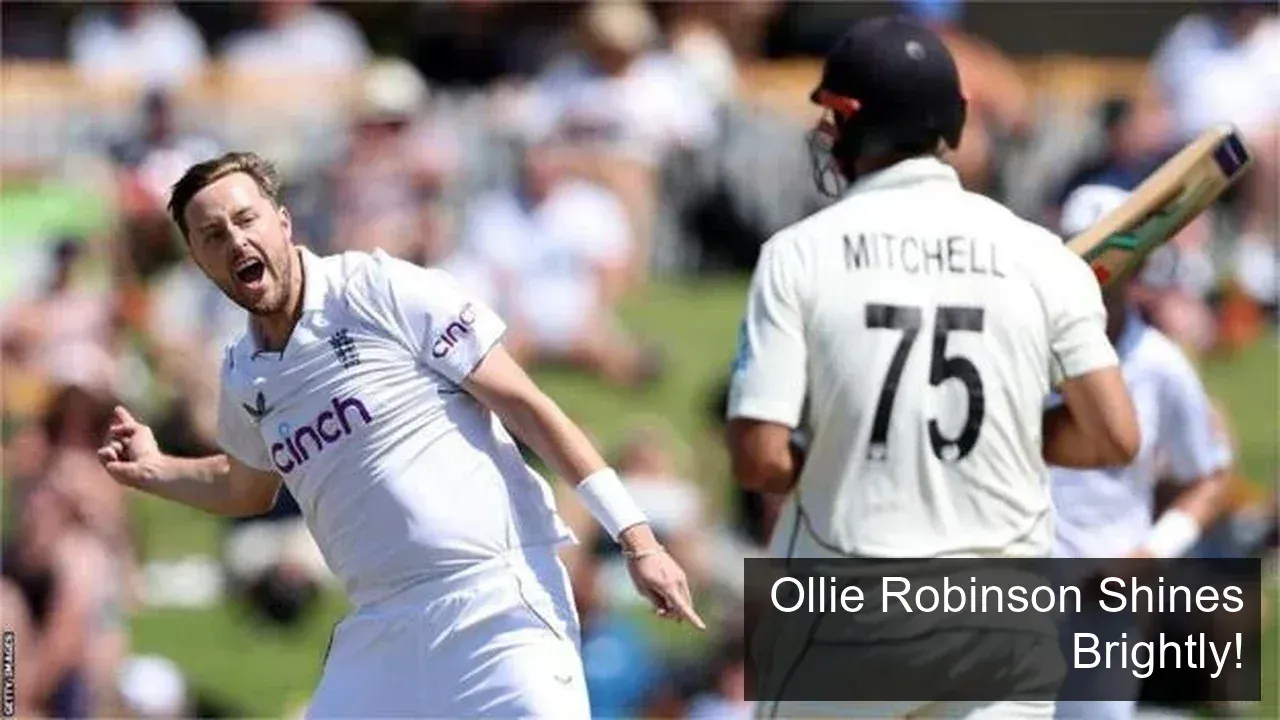
Ollie Robinson delivers a masterclass in bowling at Lord's, dismantling the New Zealand lineup with two rapid-fire wickets. England now stands just five wickets away from a critical first Test victory in the three-test series.
The first Test match between England and New Zealand at Lord's has evolved into a gripping battle of endurance and skill. In a match characterized by volatile weather and a challenging surface, Ollie Robinson has emerged as the standout performer. His ability to strike in quick succession has shifted the momentum firmly in England's favor, leaving the visitors struggling to maintain their footing in the second innings. As the match reaches a critical juncture, Robinson's precision has put New Zealand on the brink of defeat.
1. The Rapid-Fire Double Strike
The defining moment of the match occurred after a series of rain delays that washed out the morning session. Once play resumed, Ollie Robinson produced a devastating spell, removing Rachin Ravindra and Daryl Mitchell in quick succession. Rachin Ravindra, who had fought to score 8 runs, was dismissed by Robinson, which immediately heightened the pressure on the New Zealand middle order. The momentum intensified when Daryl Mitchell entered the fray; Robinson rapped him on the front pad, resulting in a three-ball duck and an LBW dismissal.
This sequence of wickets was a catalyst in reducing New Zealand to 55-5 in their second innings after 21.3 overs. Robinson's contribution in this phase is reflected in his figures of 2-18 for the second innings, adding to his overall impact in his comeback match where he has now claimed a total of seven wickets. For New Zealand, these rapid losses mean they are currently trailing by a significant margin, needing another 199 runs to secure only their second Test win at the historic Lord's ground.
2. Dominance Across the Match
Robinson's impact was not limited to the second innings. His dominance was established early in the match during New Zealand's first innings, where he claimed 5-39. This five-wicket haul was instrumental in bowling New Zealand out for 113 in 29.5 overs, with only Kyle Jamieson (38no) and Glenn Phillips (34) offering significant resistance. This early success laid the foundation for England's current advantage.
The contrast in performance is stark when looking at the full scorecard. England's first innings saw them all out for 140 in 39.4 overs, with Harry Brook scoring 56 off 71 balls. However, England bounced back in their second innings, scoring 226 all out in 56 overs, supported by Emilio Gay (57), Jamie Smith (39), and Ben Duckett (33). This collective effort, combined with Robinson's bowling, has placed England in a commanding position, with estimates suggesting an 80% chance of victory as of Saturday afternoon.
3. The Battle Against the Elements and the Pitch
The drama of the match has been amplified by chaotic weather and a controversial surface. Heavy cloud cover and a pitch that offered considerable lift and movement made batting an arduous task. Michael Atherton noted that the combination of lights and the nipping ball made batting difficult. The rain was a persistent factor on Saturday, June 6, 2026, with three separate bouts of rain breaking up the action, resulting in only 9.4 overs being possible on the third day.
The quality of the Lord's pitch has become a central talking point among experts. Nasser Hussain described the surface as "substandard" and "not good enough" for Test cricket, citing variable bounce and a lack of pace. He pointed out that 33 wickets fell within the first two days of play, a statistic that highlights the instability of the 22 yards in the middle. Former New Zealand bowler Simon Doull echoed these concerns, questioning what the ECB and MCC intend to do about the ageing wicket. To combat these issues, grounds staff attempted to improve the pitch by blowing 200°C steam onto the wicket and relaying the outfield.
4. Key Match Statistics and Standings
The statistical breakdown of the match underscores the volatility and the brilliance of the bowling attacks. A total of 35 batters have fallen in less than two days of normal play. While Ollie Robinson has starred for England, New Zealand's Nathan Smith also posted impressive numbers, taking 6-70 in England's second innings, which included four wickets in just 11 deliveries. Other notable bowlers include Gus Atkinson (2-16 in the second innings) and Josh Tongue (3-40 in the first innings).
On the batting side, the struggle was evident even for the game's greats. Joe Root and Kane Williamson combined for only 27 runs across their appearances. New Zealand's second innings has been a struggle for survival, with Devon Conway scoring just 19 runs from 55 balls. As it stands, England needs only five more wickets to take a 1-0 lead in this three-test series.
Conclusion: A Thrilling Finale Awaits
As the match moves toward Sunday, June 7, 2026, the stage is set for a thrilling conclusion. Despite the frustration of rain delays and the controversy surrounding the pitch, the quality of bowling—specifically the star performance of Ollie Robinson—has provided the highlight of the series so far. With New Zealand reeling at 55-5 and England needing five wickets for victory, the momentum is heavily weighted toward the hosts. With a forecast for no rain on Sunday, cricket fans can expect a decisive end to this high-stakes encounter at Lord's.